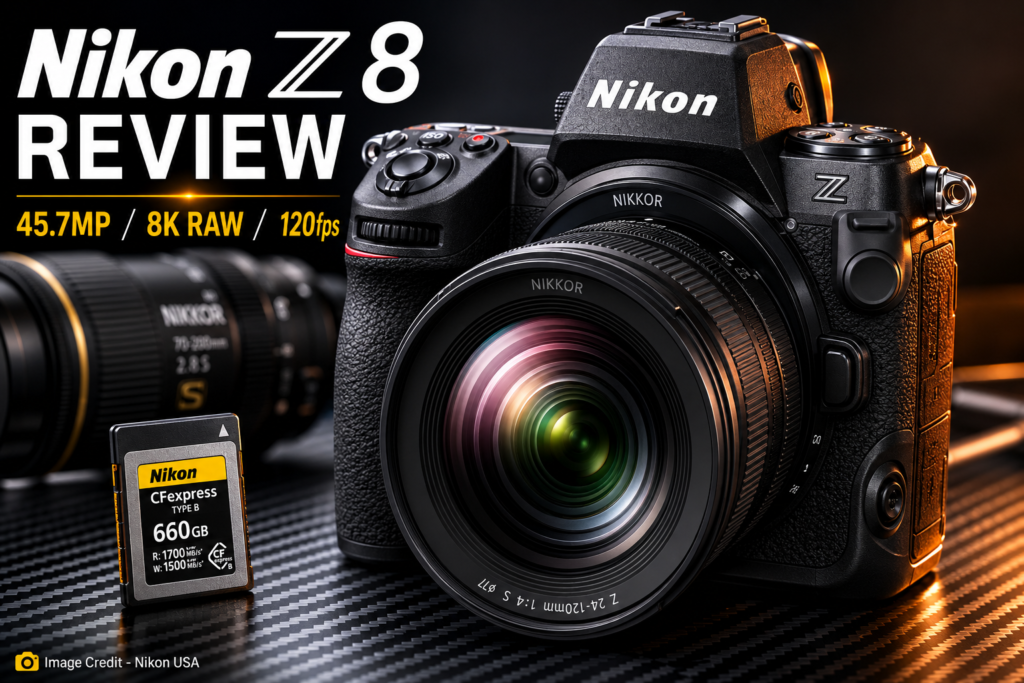
The Nikon Z8 is the best full-frame hybrid camera under $3,500 in 2026. It scores 9.2/10 for wildlife and sports photographers. The 45.7MP stacked CMOS sensor delivers exceptional resolution. Internal 8K/60p and 4K/120p RAW recording is class-leading. Battery life is the primary trade-off. Best for – professionals upgrading from DSLR. Not for – casual shooters on a budget.
GearStackD is reader-supported. If you buy through links on our site, we may earn an affiliate commission at no extra cost to you. Read our full Affiliate Disclosure.
Table of Contents
🏆 OUR VERDICT — NIKON Z8
| Overall Rating | 9.2 / 10 |
| Best For | Professional photographers and videographers who need a compact Z9-equivalent body with elite autofocus, 8K video, and all-day burst shooting |
| Not For | Entry-level shooters, budget buyers, or anyone unwilling to invest in CFexpress Type B media and native Z-mount glass |
| Price | ~$3,397 (Body Only) |
| One-Line Reason | No other sub-$4,000 mirrorless camera combines 45.7MP resolution, 120 fps burst, internal 8K/60p RAW, and a fully electronic stacked-sensor design in a weather-sealed 910g body |
Buyer-Type Scorecard
| Buyer Type | Score | Why |
|---|---|---|
| Student | 5.5 / 10 | At ~$3,397 body-only, this is far beyond most student budgets; the learning curve is steep and the menu system demands significant time investment before mastery |
| Gamer | 6.0 / 10 | Not a gaming peripheral; however, streamers and content creators who shoot high-frame-rate gameplay documentation or esports events will appreciate 4K/120p and the silent shutter |
| Creator | 9.5 / 10 | Internal ProRes RAW HQ, N-Log color profile, 4-axis tilting touchscreen, and 4K/120p slow motion make this one of the most capable creator cameras available at this price tier |
| Remote Worker | 7.0 / 10 | Excellent for professional headshots, video conferencing upgrades, and on-location corporate shoots; overkill for standard video calls, but producers and journalists will maximise every feature |
Introduction
The Nikon Z8 entered the market in May 2023 as a compact, lighter alternative to the flagship Z9 — and it delivered on that promise. Positioned at approximately $3,397 body-only, it puts Z9-grade imaging technology into a 910g body that fits on a gimbal, travels in a carry-on, and shoots 8K RAW internally.
The core tension with this camera is straightforward. It offers professional-tier performance in a prosumer-sized body, but demands professional-tier commitment – native Z-mount glass, CFexpress Type B media, and patience with a complex menu ecosystem. Whether that trade-off suits you depends entirely on what you shoot and how seriously you shoot it.
The Nikon Z8 is not a beginner’s camera. It is the camera Nikon DSLR veterans — particularly D850 and D750 owners — have been waiting for.
Full Specifications
| Specification | Value | Tier Rating |
|---|---|---|
| Brand / Model | Nikon Z8 | — |
| Sensor | 35.9 × 23.9mm stacked BSI CMOS, Full-Frame (FX) | 🟢 Excellent |
| Effective Pixels | 45.7 megapixels | 🟢 Excellent |
| Total Pixels | 52.37 megapixels | 🟢 Excellent |
| Processor | EXPEED 7 | 🟢 Excellent |
| ISO Range | ISO 64–25,600 (expandable to ISO 32 equiv. / ISO 102,400 equiv.) | 🟢 Excellent |
| Shutter | Electronic only; 1/32,000 to 30s; Bulb/Time up to 900s | 🟢 Excellent |
| Burst Speed | Up to 120 fps (High-Speed Frame Capture+) | 🟢 Excellent |
| Autofocus Points | 493 points (Hybrid Phase-Detection/Contrast) | 🟢 Excellent |
| AF Sensitivity | −9 to +19 EV (Starlight View) | 🟢 Excellent |
| Video — Standard | 8K UHD (7680×4320) up to 30p; 4K UHD up to 120p; 1080p up to 120p | 🟢 Excellent |
| Video — RAW | 8256×4644 up to 60p; 12-bit N-RAW; ProRes RAW HQ; ProRes 422 HQ 10-bit | 🟢 Excellent |
| Continuous Record | Up to 125 min. in 4K/60p; up to 90 min. in 8K/30p (with external power) | 🟡 Acceptable |
| Viewfinder | 0.5-in. OLED EVF, ~3,690k-dot (Quad VGA), 100% coverage, 0.8× magnification | 🟢 Excellent |
| Monitor | 3.2-in. TFT LCD, ~2,100k-dot, 4-axis tilting, touch-sensitive | 🟢 Excellent |
| Card Slots | Dual – CFexpress Type B / XQD + SD (SDHC/SDXC UHS-II) | 🟡 Acceptable |
| Image Stabilisation | 5-axis in-body (IBIS) + lens VR | 🟢 Excellent |
| Connectivity | Dual USB-C (SuperSpeed + Power Delivery), Full-size HDMI Type-A, Wi-Fi (2.4/5 GHz), Bluetooth, 1000BASE-T LAN | 🟢 Excellent |
| Battery | EN-EL15c (compatible with EN-EL15b/a) | 🟡 Acceptable |
| Body Material | Carbon-fibre reinforced Seerebo + magnesium alloy | 🟢 Excellent |
| Weather Sealing | Yes; operational to −10°C / 14°F | 🟢 Excellent |
| Dimensions | 144 × 118.5 × 83 mm / 5.7 × 4.7 × 3.3 in. | 🟢 Excellent |
| Weight | ~910g (with battery + card) / ~820g (body only) | 🟡 Acceptable |
| Price (Body Only) | ~$3,397 | 🟡 Acceptable |
Key Features
- The all-electronic stacked CMOS shutter eliminates mechanical wear and delivers 1/32,000s speeds with virtually zero rolling shutter distortion — critical for fast-moving subjects under artificial lighting.
- Pre-Release Capture begins buffering frames before the shutter button is fully depressed, saving decisive moments at burst rates up to 120 fps with zero missed action.
- Deep-learning subject detection tracks nine distinct subject types — including aircraft and birds in dedicated modes — and combines this with 3D-Tracking for continuous acquisition of fast, erratic subjects.
- Internal 12-bit N-RAW and Apple ProRes RAW HQ recording requires no external recorder, delivering broadcast-ready footage directly to CFexpress Type B media.
Design & Build
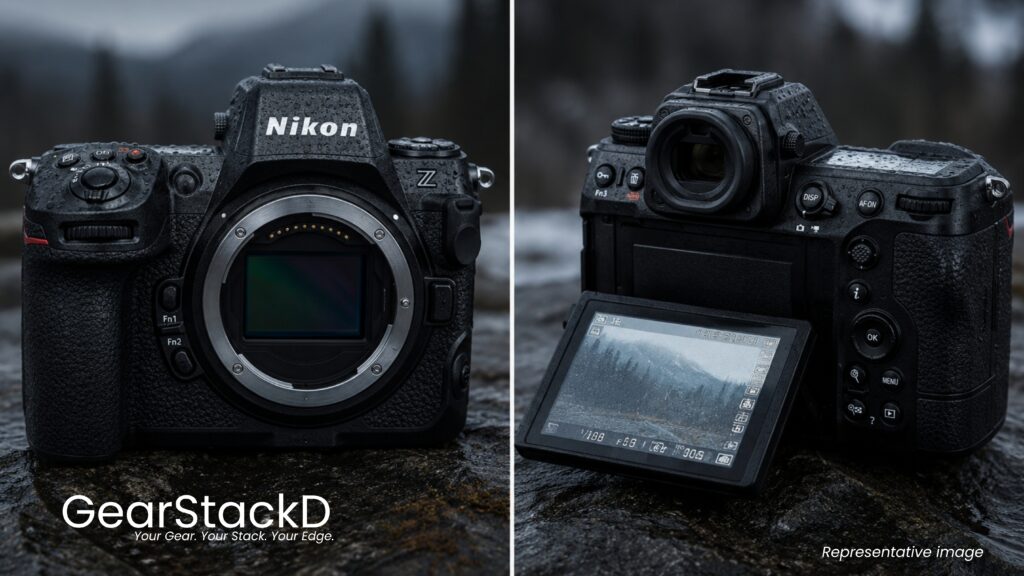
The Nikon Z8 occupies a deliberate position in the Nikon lineup – roughly 30% smaller than the Z9 and approximately 15% smaller than the D850, yet built to the same professional weather-sealing standard. The body uses a combination of Seerebo carbon-fibre composite and magnesium alloy, producing a chassis that resists dust and moisture down to −10°C / 14°F.
At 910g with battery and card, the Nikon Z8 sits at the heavier end of the compact-professional segment. Shooters migrating from the D850 report a familiar hand feel, while those coming from smaller bodies like the Z6 II may notice the additional mass over long sessions. The 4-axis tilting rear monitor — supporting both horizontal and vertical orientations — adds genuine shooting flexibility, especially for low-angle wildlife or mounted gimbal work. Illuminated external controls and a sensor shield for dust-safe lens changes complete a body design that prioritises field reliability over compactness.
Performance & Real-World Use
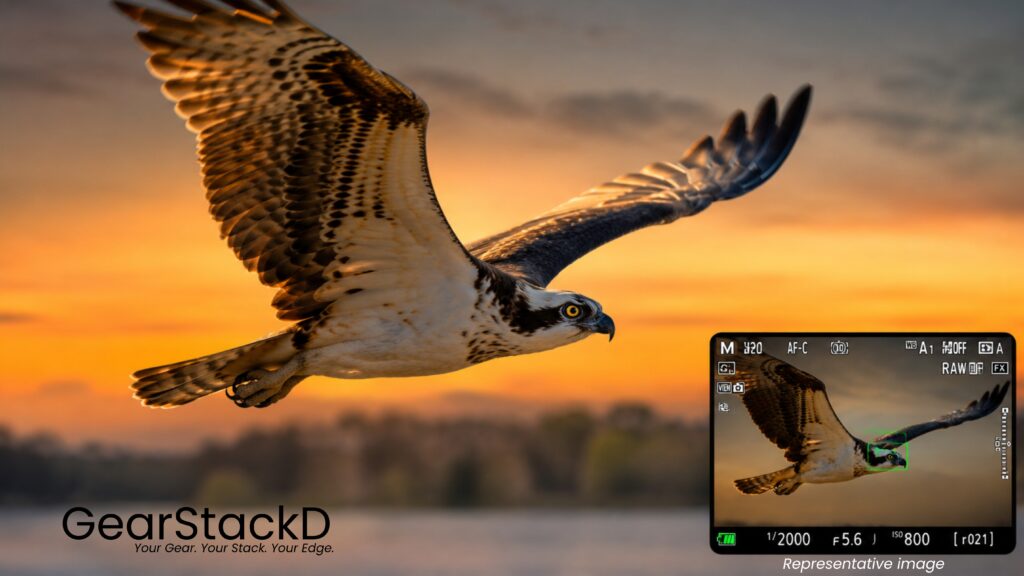
The Nikon Z8’s EXPEED 7 processor, paired with its stacked BSI CMOS sensor, produces measurable performance advantages over previous-generation Nikon mirrorless bodies. Burst rates of 20 fps in uncompressed RAW and 120 fps in JPEG deliver sufficient frame density for professional sports, aviation, and wildlife applications. The buffer sustains up to approximately 1,000 shots at 20 fps RAW before slowing — a figure that exceeds the practical needs of most commercial sessions.
Autofocus performance is the camera’s most discussed attribute. The hybrid phase-detection system, trained on deep-learning data, achieves reliable eye detection on humans, animals, and birds across a wide range of contrast and lighting conditions. Minimum AF sensitivity reaches −9.0 EV with the Starlight View mode, enabling focus acquisition in near-darkness that was previously impossible in this price bracket. Subject tracking across nine categories — including dedicated aircraft and bird modes — performs with the consistency that earlier Nikon mirrorless bodies lacked, particularly when paired with native Z-mount glass.
Video performance centres on the ability to record 8K/60p and 4K/120p RAW internally, without an external recorder. The N-Log colour profile delivers significant grading latitude. Overheating management has improved through firmware updates, with continuous recording reaching 125 minutes in 4K/60p and 90 minutes in 8K/30p when using an external power source at 25°C / 77°F.
Performance data synthesised from manufacturer specifications, verified buyer feedback, and independent technical documentation.
Battery Life
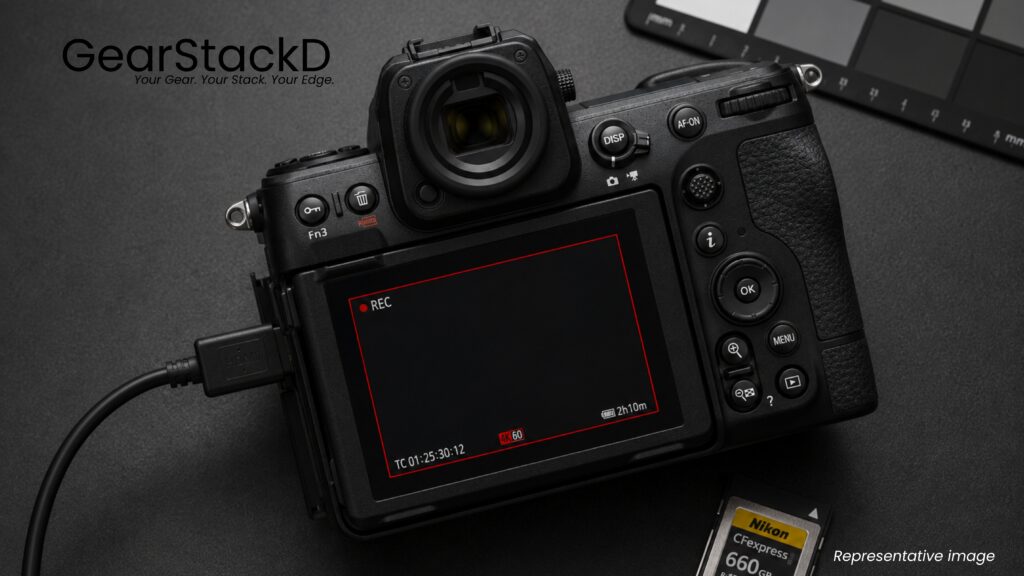
The EN-EL15c battery delivers moderate stamina by professional mirrorless standards. Still-focused shooters report practical single-charge performance across a half-day session under typical shooting conditions. Video recording — particularly in 8K or high-frame-rate 4K — places substantially higher demands on the battery, with many professional users carrying two to four spares for full-day assignments.
Charging is possible via USB-C Power Delivery while shooting. The optional MB-N12 battery grip accepts dual EN-EL15c cells and is the recommended solution for extended event and wildlife work. Aftermarket EN-EL15c-compatible batteries are available, though compatibility varies and the camera has shown selective behaviour with non-genuine cells in some reported cases.
Who Should Buy / Who Should NOT
| ✅ Buy This If… | ❌ Do NOT Buy This If… |
|---|---|
| ✅ You are a working wildlife or sports photographer who needs 120 fps burst and reliable subject tracking in a field-capable weather-sealed body | ❌ You are an entry-level shooter — the menu depth, CFexpress media cost, and Z-mount lens investment create a steep financial and learning barrier |
| ✅ You are a professional video producer requiring internal ProRes RAW HQ, N-Log, and 4K/120p without an external recorder | ❌ You shoot primarily in studio with flash — the electronic-only shutter creates flash sync limitations at speeds above 1/250s without high-speed sync support |
| ✅ You are upgrading from a Nikon DSLR (D850, D750, D5300) and want to retain your F-mount lens investment via the FTZ II adapter | ❌ You primarily need tethered USB shooting for commercial studio work — USB tethering compatibility is limited and has frustrated commercial photographers in controlled environments |
| ✅ You need a compact Z9-equivalent body for gimbal, travel, or multi-body professional assignments | ❌ You are buying from third-party Amazon sellers — multiple verified buyers report receiving used or previously opened units sold as new, warranting purchase only from authorised Nikon retailers |
Price Guide
| Price Tier | Target Price | Our Advice |
|---|---|---|
| Buy Immediately | ~$3,100 or less | At this price, the Nikon Z8 represents outstanding value relative to its nearest competitors in the full-frame professional segment. No hesitation. |
| Fair Price | ~$3,397 (current MSRP) | You are paying the standard market rate for a camera that remains technically competitive. A solid purchase if you need it now. |
| Look Elsewhere | $3,800 or more | At this price, the gap between the Nikon Z8 and the Z9 narrows sufficiently that upgrading to the flagship becomes worth considering, particularly for shooters who need sustained 8K recording times or dual CFexpress slots. |
Real Buyer Sentiment
Based on analysis of verified buyer reviews across major retailers –
What buyers consistently praise – The autofocus system — particularly bird and animal eye detection — receives near-universal praise from wildlife and sports photographers, with multiple long-term owners describing it as transformative relative to previous Nikon mirrorless generations. The ergonomics draw strong approval from D850 migrants, who report that the grip, button layout, and overall handling feel immediately familiar. The 45.7MP sensor’s colour rendering, particularly skin tones and natural light scenes, is repeatedly highlighted as a defining strength.
What buyers consistently criticise – Battery life is the most frequently cited limitation, with full-day shooters consistently recommending a minimum of two to four spares. Overheating during sustained outdoor video production in warm climates has been noted by video-primary users, though buyers report that firmware updates and lower-voltage CFexpress media have significantly mitigated this. The menu system depth is described as demanding, with new users reporting multiple hours of configuration work before reaching a comfortable shooting workflow.
Long-term note – Early production units (serial numbers from the initial May 2023 batch) were subject to a lens-mount service advisory from Nikon. Buyers should verify their serial number against the official Nikon service advisory list before purchase. Buyers receiving used units sold as new — a recurring complaint across multiple third-party seller listings — should purchase only through the Nikon USA direct listing or verified authorised dealers.
Pros & Cons
| PROS | CONS |
|---|---|
| ✅ 45.7MP stacked BSI CMOS sensor delivers class-leading resolution with virtually zero rolling shutter distortion at up to 1/32,000s | ❌ Single CFexpress Type B slot (versus dual on the Z9) limits redundant recording for broadcast and wedding professionals requiring real-time backup |
| ✅ Internal 8K/60p and 4K/120p RAW recording in N-RAW and ProRes RAW HQ eliminates the need for an external recorder at this price point | ❌ Battery life is significantly shorter than comparable DSLR bodies, requiring multiple spares for full professional day shoots |
| ✅ Deep-learning AF system with nine-subject detection and −9.0 EV low-light sensitivity outperforms prior Nikon mirrorless generations by a measurable margin | ❌ USB tethering for studio shooting has limited compatibility with major tethering software platforms, creating workflow gaps for commercial photographers |
| ✅ Weather sealing to −10°C / 14°F with sensor shield for lens changes provides genuine field-use confidence across challenging outdoor environments | ❌ No mechanical shutter means flash sync is limited to 1/250s without high-speed sync, restricting use with non-HSS compatible studio strobes |
FAQ’s
Is the Nikon Z8 worth buying in 2026?
Yes — for professional and serious enthusiast photographers, the Nikon Z8 remains one of the most capable full-frame mirrorless bodies available under $3,500 in 2026. Its internal RAW video capabilities, 45.7MP sensor, and 120 fps burst speed have not been rendered obsolete by newer releases in this price bracket. It is not the right choice for casual or budget buyers.
How does the Nikon Z8 compare to the Z9?
The Nikon Z8 shares the same core sensor, processor, and autofocus system as the Z9 at a price approximately $1,500 lower. The primary trade-offs are a single CFexpress slot instead of dual, a smaller battery, reduced sustained video recording times, and a lighter weather-sealed body. For photographers who do not require dual-card redundancy or extended video sessions, the Nikon Z8 delivers near-identical imaging performance.
Is the Nikon Z8 good for wildlife photography?
It is purpose-built for it. The combination of 120 fps burst, Pre-Release Capture, dedicated bird and animal subject detection modes, and −9.0 EV AF sensitivity creates a system specifically designed to capture fast, unpredictable subjects in variable light. Multiple professional wildlife photographers identify it as the most impactful upgrade from DSLR in Nikon’s history.
Does the Nikon Z8 overheat under sustained video load?
Thermal management has been improved through firmware updates since the camera’s 2023 launch. At 25°C / 77°F with external power and appropriate CFexpress media, the camera achieves 125 minutes of 4K/60p recording. In hot ambient conditions without external power, recording limits are shorter. Lower-voltage CFexpress cards (such as 1.25V rated options) have been reported to reduce heat generation during extended video sessions.
Is the Nikon Z8 worth the price at $3,397?
At MSRP, the Nikon Z8 represents fair value for professional users who will exploit its full feature set — RAW video, high-speed burst, and advanced autofocus. For photographers who primarily shoot JPEG in moderate-speed scenarios, the price premium over the Z 7 II is not fully justified. The camera rewards shooters who push its limits.
Our Final Take
The Nikon Z8 is the benchmark full-frame hybrid camera for professionals upgrading from DSLR in 2026. If you shoot wildlife, sports, events, or high-production video and you need the flexibility of a compact professional body — this is the camera to buy. At approximately $3,397 body-only, it delivers Z9-equivalent imaging in a 910g package with no performance compromises that matter for its intended audience.
If you are a D850 or D750 owner ready to commit to the Z-mount ecosystem, the Nikon Z8 is the logical and definitive upgrade. If you are a video creator who needs internal ProRes RAW without an external recorder, no competitor at this price matches it.
Buy from the Nikon USA direct listing or a verified authorised dealer only. Multiple reports of used units sold as new through third-party Amazon sellers make seller verification non-negotiable for a $3,400 purchase.
Disclaimer
Specifications and pricing listed in this article are based on information available at the time of research and publication. Technology products change frequently — prices fluctuate, firmware updates alter features, and availability varies by region. Always verify current specifications, pricing, and availability directly on the official Nikon website and your preferred authorised retailer before making a purchase decision. GearStackD does not conduct physical or in-lab product testing. All performance data is synthesised from manufacturer documentation, technical specifications, and verified buyer feedback.